
Table of Contents
The Snapshot
- A static spray ball at 2 bar delivers 0.1 to 0.3 bar of impact at 1.5 m. Many residues need the 0.5 to 1.0 bar band.
- One rotating tank cleaning nozzle moves 40 to 120 L/min at 2 to 4 bar. It covers vessels from 2 to 6 m in diameter.
- A rotary jet head needs 150 to 500 L/min at 5 to 8 bar. A 300 L/min duty at 6 bar asks for 2.94 kW of hydraulic power.
- Exchange cleaning a 1,000 L vessel at 150 L/min takes 20 to 40 minutes, from 3 to 6 published volume exchanges.
A spray ball can fail an audit quietly. A 5,000 L process tank looked clean through weekly visual checks for months. A coverage test three weeks before a third-party audit found about 15 percent of the wetted surface shadowed by an agitator shaft and a thermowell. The stop cost four hours of lost line time, plus dumped rinse batches worth about 3.3 m3 on a 20 m3/day line.
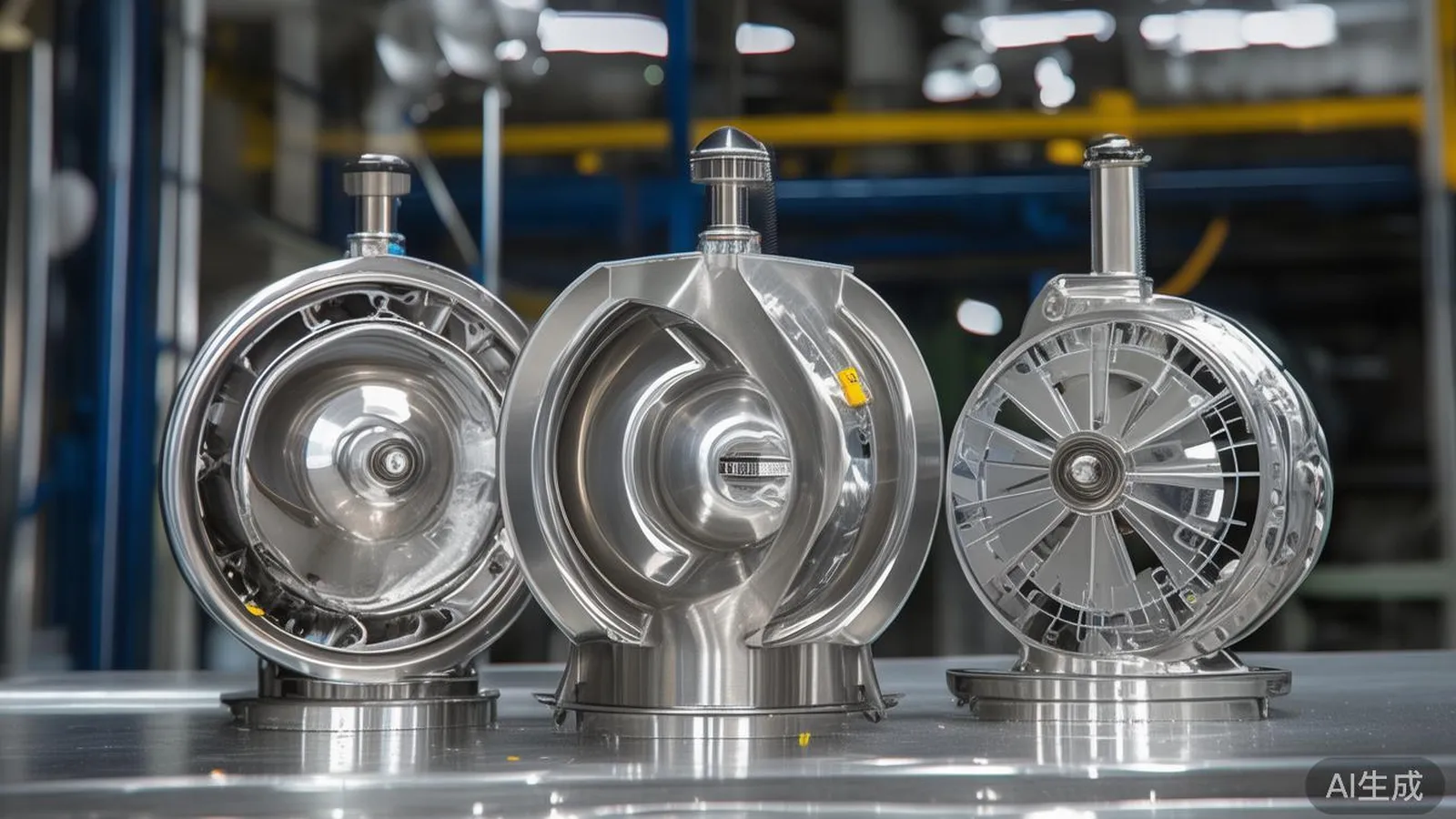
That outcome is a class mismatch, not a pump accident. The three tank cleaning nozzle types deliver energy differently: fixed orifices, one spinning outlet, or two indexed jet axes. Only the second and third hold 0.5 to 1.0 bar at the soil surface, where dried syrup, coating film and yeast cakes release. The rest of this guide prices that difference in coverage, water, kW and evidence, for one vessel at a time.
What Each Cleaner Class Actually Is
A static spray ball, the cip spray ball of dairy and brewing piping, has zero moving parts. Supply pressure of 1.5 to 3 bar pushes liquid through 30 to 200 fixed orifices drilled in a hemisphere. Published coverage reaches about 1.5 to 2.5 m radius, and the spray acts as a flowing film rather than a percussion tool. Buy the class for rinse duty and loose, fresh soil, not baked residue.
Ball duty usually follows a CIP header that already exists, at 15 to 80 L/min per unit. On a 5 m jacket with roughly 25 m2 of wetted area, one static tank cleaning head rarely reaches the whole shell. Designers then place two or three balls on a ring main and accept the higher total flow. A sanitary spray ball in 316L is the common food-grade choice, with the same coverage limits.
A rotating tank cleaning nozzle, sold across the rotary tank cleaning nozzles and tank washing heads families, runs on hydraulic energy. Its drive is fluid: supply liquid spins one internal turbine, and the assembly carries a single moving part on a bearing. One or two fan outlets sweep a spiral or star pattern from that axis at 20 to 100 rpm. This tank washing nozzle class sits between the ball and the jet head in both water and impact. Our tank cleaning selection framework sorts the sub-styles.
Rotating heads divide into spiral and star families. A spiral head projects one fan along a rising helix, while a star head sweeps a rosette with 4 to 12 points. Below about 2 bar the turbine slows, rpm collapses, and the pattern degrades into drips. Plant staff often report that as a blocked nozzle, so check inlet pressure at the nozzle before pulling it.
A rotary jet head indexes a jet around two axes, driven only by jet reaction through an internal gear train. Expect 5 to 8 bar at the nozzle and published coverage diameter bands up to 12 m and above. Mechanics, gearing and pattern design live in our rotary jet head guide; here we compare only what each class costs and earns.
| Item | Static spray ball | Rotating nozzle | Rotary jet head |
|---|---|---|---|
| Coverage diameter range | 3 to 5 m, published range | 2 to 6 m, published range | 4 to 12 m, published range |
| Impact at stated pressure | 0.1 to 0.3 bar at 2 bar, at 1.5 m | 0.5 to 1.0 bar at 3 to 6 bar | 1.0 bar and above at 5 to 8 bar |
| Flow demand L/min | 15 to 80 | 40 to 120 | 150 to 500 |
| Supply pressure bar | 1.5 to 3 | 2 to 4 | 5 to 8 |
| Pump kW, worked 5,000 L vessel | 0.13 hydraulic | 0.52 hydraulic | 2.94 hydraulic |
| Soil class it clears | Fresh film, dust, loose rinse soil | Syrup, brew residues, light polymer smears | Dried coating, resin film, sludge scale |
| Validation evidence | Rinse endpoints, occasional coverage map | Coverage test plus impact statement | Full coverage map, TOC, conductivity records |
| Typical failure mode | Shadow zones, no impact margin | Bearing wear, rpm loss below 2 bar | Plugged jet, dead-leg shadow at 3 m |
| Capital band direction | Low | Medium | High, plus reclaim loop |
Coverage Physics You Cannot Buy Your Way Out Of
Coverage is geometry before it is hydraulics. The planning rule reads width = 2 x distance x tan(theta/2), with theta as the full spray angle in degrees. A 60 degree fan on a rotating nozzle at 2 m gives width = 2 x 2 x tan(30 degrees). That is 4 x 0.577 = 2.31 m of target per pass. The jet head case: a 30 degree cone at 4 m gives 2 x 4 x tan(15 degrees) = 8 x 0.268 = 2.14 m. A wider 35 degree cone at 6 m gives 2 x 6 x tan(17.5 degrees) = 12 x 0.315 = 3.78 m.
A spray ball never projects one clean fan. It issues many small sheets instead. The planning rule becomes a coverage factor: orifice count times orifice area should reach at least 1.0 over the wetted area. The assumption is one ball, clean holes, and 1.5 to 3 bar supply. A 12 m2 jacket therefore wants about 180 mm2 of open area at our planning value of 15 mm2 per m2.
Shadow zones decide the outcome: agitator shafts, thermowells, dip tubes, spray rings and coil hangers. Map them on paper before buying anything, because no class prints liquid around a corner. Dead legs longer than about three pipe diameters stay dry under any head you choose. The cone-bottom cleaning guide covers floor angles that defeat static sheets on their own.
Raising supply pressure does not fix a ball. A cleaning nozzle for tank cleaning duty inherits the room’s airflow, so ducted vessels deserve a coverage test even on paper layouts.
Impact Level and What Soil Needs
Impact is dynamic pressure at the wall, and jet velocity rises with the square root of supply pressure. A 2 bar ball sheet leaves its orifices in the published low-pressure velocity band and collapses into droplets within 1.5 m. Measured surface impact then lands around 0.1 to 0.3 bar. Sticky soil released needs 0.5 to 1.0 bar at the surface, a published planning band. A spray ball cannot reach that band at distance because sheet breakup, not pump size, sets the ceiling.
A rotating tank cleaning nozzle concentrates the same liquid into fewer, faster sheets. At 3 to 6 bar it holds the 0.5 to 1.0 bar band across its published radius. Spiral dwell adds repeated passes over each point. A rotary jet head at 5 to 8 bar exceeds 1.0 bar at mid radius and breaks films that need shear plus time.
Soil chemistry closes the loop. Fresh milk rinses under films near 0.1 bar. Dried syrup needs soaking plus 0.5 to 1.0 bar. Cured coating film asks for the jet head and usually heat at 60 to 80 degrees C. Dwell substitutes for impact within limits: a weak pattern held 10 minutes can beat one hard 30 second pass on soluble soil. It never beats it on cured polymer.
The same physics shows up outside the process hall. Scrubber spiral nozzle retrofits trade fine mist for heavier sheets when deposits harden on the wall. The lesson transfers: change the momentum class, not just the count of holes.
The Water and Pump Bill
Take one vessel, a 5,000 L jacket, and price the three classes honestly. Hydraulic power follows kW = Q(L/min) x P(bar) / 612. Published overall pump efficiency runs 60 to 75 percent, so divide hydraulic kW by 0.70 for shaft power. Unit checks stay plain: 1 m3 = 1000 L, 1 gpm = 3.785 L/min, 1 bar = 14.5 psi, and 1 hp = 0.746 kW.
| Class | Q L/min | P bar | Hydraulic kW | Shaft kW at 70 percent | Once-through volume per 20 min cycle |
|---|---|---|---|---|---|
| Spray ball, 14 mm, 30 holes | 53.7 | 1.5 | 0.13 | 0.19 | 1.07 m3 |
| Rotating nozzle | 100 | 3.2 | 0.52 | 0.75 | 2.0 m3 |
| Rotary jet head | 300 | 6.0 | 2.94 | 4.20 | 6.0 m3 |
The ball figure comes from the orifice equation, applied per hole. Q(L/min) = 0.65 x d(mm)^2 x sqrt(P(bar)), with Cd built in near 0.95. One 1.5 mm hole at 1.5 bar passes 0.65 x 1.5 x 1.5 x 1.225 = 0.65 x 2.25 x 1.225 = 1.79 L/min. Thirty holes give 30 x 1.79 = 53.7 L/min, inside the 15 to 80 L/min band. Then kW = 53.7 x 1.5 / 612 = 0.13 hydraulic and 0.13 / 0.70 = 0.19 kW shaft.
The rotating case reads kW = 100 x 3.2 / 612 = 0.52 hydraulic, then 0.52 / 0.70 = 0.75 shaft. That is about 1.0 hp, since 0.75 / 0.746 = 1.0. The jet head reads kW = 300 x 6.0 / 612 = 2.94 hydraulic and 2.94 / 0.70 = 4.20 shaft, or 5.6 hp. The 6 bar header is a 6 x 14.5 = 87 psi circuit, which a plant should recognize before ordering.
Flow tracks pressure, not angle: GPM2 = GPM1 x sqrt(P2/P1). Take a head rated 88 L/min at 5 bar. At 3 bar it sees 88 x sqrt(3/5) = 88 x 0.775 = 68 L/min, a 23 percent shortfall. The spray angle never changes, which surprises everyone the day the coverage map fails.
Exchange time follows cleaning minutes = tank volume (L) / supply flow (L/min) x number of exchanges, published at 3 to 6 exchanges. A 1,000 L vessel at 150 L/min takes 1000 / 150 = 6.67 minutes per exchange. Three exchanges take 20 minutes, and six take 40. On our 5,000 L jacket at 100 L/min, three exchanges mean 150 minutes once-through.
Heating is the hidden half of the bill. Warming 2 m3 of makeup from 10 to 70 degrees C takes 2000 x 4.186 x 60 = 502 MJ, near 139 kWh. Pump energy, 4.20 kW over 20 min, is only 4.20 x (20 / 60) = 1.40 kWh. A CIP washing system loop recirculates heated solution and cuts makeup to 0.5 to 1.0 m3 per cycle. The jet head’s water problem is mostly solved by plumbing, not by a smaller nozzle.
Sanitary, Standards and Validation Evidence
Sanitary vessels pull the strongest documentation. 3-A sanitary 67-06 and ASME BPE govern surface finish, drainability and cleanability of the fittings. 316L spray balls and rotating heads are commonly electropolished below 0.8 micrometers Ra. EHEDG guidelines frame the design gap question: no crevice the wash class cannot reach. Units follow ISO 80000 so bar, L/min and kW stay unambiguous inside protocols.
Evidence, not opinion, closes a validation. The riboflavin coverage test is the published method, and our pharma vessel CIP validation case walks the paperwork. Coat the wetted surface with a 0.5 to 1.0 g/L solution, run the wash, then map fluorescence under UV. Site protocols commonly pass at 5 to 10 percent uncovered area. Rinse endpoints run on conductivity within 5 uS/cm of feed water, or TOC in a site window.
Hazardous duties add a different check. Flammable residues bring NFPA 30 classification and ASTM D93 flash point data into the wash plan. OSHA 1910 governs entry, ventilation and lockout during nozzle work on open vessels. A fixed tank cleaning nozzle on an atmospheric storage tank is a fire-water conversation, not a CIP one.
Decision Path
Walk the sequence in order, because later answers depend on earlier ones. Start with soil class. Loose rinse soil keeps the spray ball option open. Anything dried, cured or sticky moves you to a rotating tank cleaning nozzle or above, and cured coatings usually force the jet head.
Then measure geometry. Record diameter, straight shell height, floor shape and every shadow you already know about. Vessels wider than 6 m, or taller than 4 m of straight shell, usually push past one static head per ring. Our class overview maps those boundaries against vessel size.
Next, audit utility limits. A 4 bar header cannot feed an 8 bar jet without a dedicated booster, and the shaft kW column in the pump table sizes it. Confirm drain capacity and reclaim volume before promising exchange counts on a cycle sheet.
Then define the regulatory evidence. If a coverage map plus TOC records must exist, specify the nozzle so the test can physically pass at design flow. Keep the datasheet, the riboflavin photos and the endpoint trend in one validation package.
Finally cost. Capital spread between classes is small next to annual wash duty. Cycles, downtime and labor dominate the total, as both switching cases below show. A bench nozzle swap takes 0.5 h, while a failed audit closes a line for four.
Switching Cases: When The Step Up Pays
Case one: a 3,000 L coatings tank with cured resin film, using spray balls for cleaning tanks on a 2 bar header. Weekly duty ran a 45 min cycle plus 2 h of hand scrub, four cycles a week, roughly 14 h of labor. The retrofit chose one rotary jet head at 300 L/min and 6 bar.
Cycle time fell to 20 min once-through, and the duty costs 1.40 kWh per cycle, 5.6 kWh over four. Water climbed to 24 m3 per week once-through, then dropped to 4 to 6 m3 of makeup with reclaim. The trade is 14 h of weekly labor against modest energy and a plumbing project. A coatings plant cleaning machine case shows the same arithmetic at larger scale.
Case two: a 500 L blend vessel with light powder residue, upgraded from a fixed tank cleaning nozzle for a validation-driven audit. One rotating tank washing nozzle at 60 L/min and 3 bar needs kW = 60 x 3 / 612 = 0.29 hydraulic. Dividing by 0.70 gives 0.42 shaft kW. The duty CIP pump handles that without a new circuit.
A rotary jet head at 150 L/min and 5 bar would ask 150 x 5 / 612 = 1.23 hydraulic. The soil never exceeded the 0.5 to 1.0 bar band, so the smaller step passed the coverage test and the endpoint. The larger step was pure cost, plus a bearing maintenance plan nobody needed. Buy the class the soil proves, not the class a vendor demonstrates well.
Cost Drivers And Downtime Risk
Rank the drivers before signing anything. Energy at 1.40 kWh per cycle is trivial against 14 h of weekly scrub labor in case one. Rework cycles dominate the total: one failed validation costs four hours of line time and every held batch behind it.
Spare-part risk scales with moving parts. A spray ball with zero of them fails by plugging, and the fix lives on the strainer mesh guide. One rotating tank cleaning nozzle adds a bearing and a documented service interval. A rotary jet head adds gears and seals to that plan, and a plugged jet stops coverage at one point. Water and heat usually outweigh all of it: dairy CIP tank cleaning cycles show rework rinse as the silent volume driver.
Common Selection Errors
| Error | The number to check | The fix |
|---|---|---|
| Adding pressure to a spray ball for impact | 2 to 4 bar lifts flow 41 percent, impact unchanged | Change class, not header |
| Sizing a jet head at pump discharge | 3 bar at the nozzle, not 5, cuts flow to 68 L/min | Compute line and fitting pressure drop |
| Running worn outlets past inspection | 5 percent bore wear gives 10.25 percent over-delivery | Replace at the 5 percent limit |
| Ignoring dead legs | Legs over 3 pipe diameters stay dry under any head | Trace and map before specifying |
| Under-sizing return and makeup lines | 3 to 6 exchanges on 5,000 L moves 15 to 30 m3 | Size the loop, not the nozzle alone |
| Skipping the coverage test after retrofits | About 15 percent shadow area hid for months | Run it at design flow after every change |
| Choosing a spray head for tank cleaning by catalog habit | Film soil needs 0.5 to 1.0 bar impact | Spec from soil data, not habit |
Materials And Life
Bodies run 316L stainless for sanitary and heat duty. PP covers about 60 to 80 degrees C chemical service, and PVDF takes hotter aggressive cycles. Our plastic nozzle line lists both polymer bodies where chlorides pit metal. Seal compounds matter as much as bodies: check each elastomer against the detergent window.
Moving classes earn hardened internals. Ceramic or tungsten carbide inserts in rotating and jet heads resist the abrasive scale that ruins softer orifices within one season of sludge duty. Wear math is unforgiving because flow scales with the square of diameter. A plus 5 percent outlet gives (1 + 5/100)^2 - 1 = 1.1025 - 1 = 10.25 percent over-delivery.
A plus 10 percent bore delivers (1 + 10/100)^2 - 1 = 21 percent more flow, with a pattern that collapses. Published inspection practice runs monthly on heavy sludge duty and quarterly on light rinse service. Record bore diameter with a pin gauge every time and replace on the trend, not on luck. IBC tote and drum rinse stations show how polymer balls survive daily detergent contact where plated steel pits.
FAQ
Can raising spray ball pressure fix impact?
No. Pressure changes flow, not angle: going from 2 to 4 bar lifts one ball by sqrt(4/2) = 1.41, about 41 percent more L/min. Surface impact stays under 0.3 bar at 1.5 m because sheet breakup sets the ceiling. Step to a rotating class instead of the header.
Which tank washing nozzle handles dried syrup?
A rotating tank cleaning nozzle at 3 to 6 bar holds the 0.5 to 1.0 bar band that syrup needs. Tank washing nozzles in that class move 40 to 120 L/min, so confirm reclaim before committing. Heat at 60 to 80 degrees C shortens the soak and the dwell.
What does a spray head for tank cleaning need on a 4 m vessel?
Start with the coverage factor rule: 1.0 or better over the wetted area, near 180 mm2 open area for a 12 m2 jacket. A 30-hole, 14 mm cip spray ball at 1.5 bar gives 53.7 L/min, enough for a rinse pass on that shell. For baked soil, choose the rotating tank cleaning nozzle class instead.
Is tank washin heads a different product?
No. It is a misspelling of tank washing heads, the rotating family with one turbine-driven moving part. Search the correct form when comparing flow curves in L/min at 2 to 4 bar. Catalog listings also group them under rotary tank cleaning nozzles.
How much pressure does a rotary jet head really need?
Published bands start near 5 bar at the nozzle, not at the pump discharge. A head rated 88 L/min at 5 bar delivers only 88 x sqrt(3/5) = 68 L/min at 3 bar. That 23 percent loss breaks coverage on a 6 m shell. Measure at the inlet fitting during commissioning.
How do I prove coverage after a retrofit?
Run the riboflavin method at design flow with a 0.5 to 1.0 g/L coating, then photograph the fluorescence map. Log rinse conductivity within 5 uS/cm of feed water as the chemical endpoint. Repeat after any bearing or insert change, typically at the 5 percent wear limit.
The Bottom Line
Pick the wrong cleaner class and a hygiene problem becomes an audit finding. A spray ball cannot reach 0.5 to 1.0 bar at the wall. A rotary jet head cannot rinse on a 1 bar gravity header. A bigger pump fixes neither and raises the water and kW bill.
Send us the vessel dimensions, the soil description, and your measured pressure and flow at the nozzle inlet. We will match tank cleaning nozzle types to published curves and map your shadow zones before purchase. See notes on our tank cleaning applications page. Start the review at our engineering desk and receive a sizing sheet showing every substitution.
Next Step
Send the Duty. Get Sized Nozzles Back.
Send your flow, pressure, fluid and target coverage. We come back with nozzle options and figures, not a catalogue number.
Written by
Ray ChanIndustrial spray nozzle specialist. I size tank cleaning, atomizing, flat-fan and spiral nozzles against real duty conditions, flow, pressure, fluid and target, rather than catalogue numbers. Every guide here comes from actual sizing work.