
Table of Contents
A 20 ft tank container can hold 26,000 L of product, and it is never truly empty. A heel of 0.5 m3 left in the sump after a wash is enough to spoil the next cargo. On a hazardous class the same heel can void a shipping document. A rejected tank then sits on a chassis instead of a ship, and the booking clock runs the whole time.
This guide is about the depot side of that problem. It treats iso tank cleaning as a fixed depot process with a repeatable cycle. It covers how a 20 ft frame tank container gets cleaned between cargoes. It looks at product switching, the T11 to T50 residue classes, nozzle and rotary jet head selection, cleaning time, water math, verification and cost. Every figure here is a published class value, not a plant record.
The Snapshot
- A 20 ft frame tank container holds 17,500 to 26,000 L inside a stainless shell about 2.4 m across.
- A fluid-driven rotary jet head reaches 3 to 13.7 m of radius at 3 to 15 bar and 10 to 150 L/min.
- Pattern time runs 30 to 60 seconds per metre of sweep, so a 26,000 L vessel needs about 5.0 minutes.
- A three-stage counterflow rinse cuts fresh water from 4.8 m3 to 2.0 m3 per vessel, a 58 percent saving.
Why ISO Tank Cleaning Is Hard
The difficulty starts with the booking sheet. A depot cleans whatever the last customer shipped, and then turns the same vessel around for the next one. There is no single product, no single soil and no single cycle.
Depots sort the work by the last cargo. Wine and light liquids move through a lane with a warm rinse. Non-hazardous oils move through a lane built for oily film.
Hazardous chemicals and acids need their own wash, their own disposal and their own paperwork. Liquefied petroleum gas and ammonia sit in a separate class again. The cleaning method follows the class, not the tank.
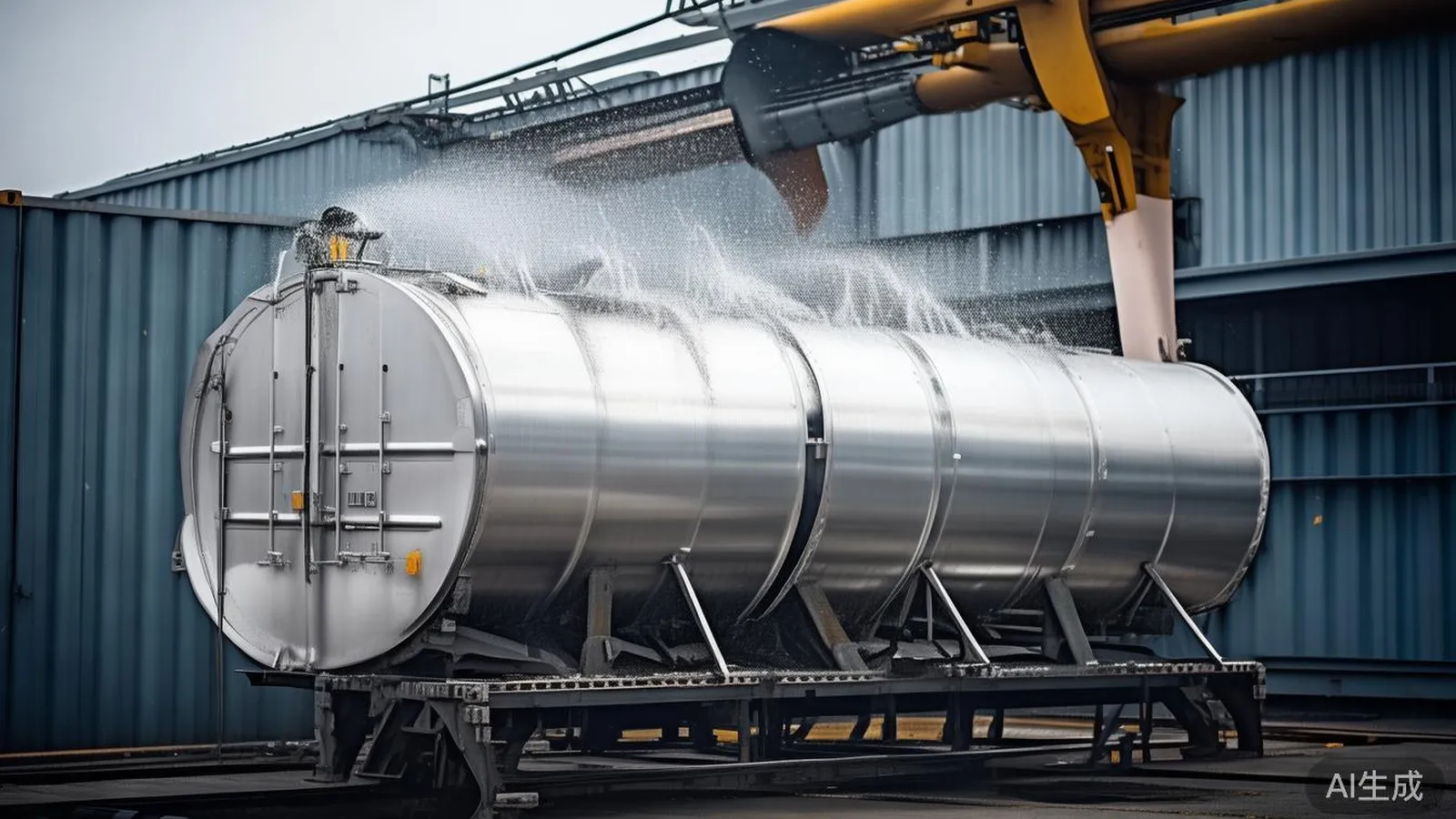
A tank container is a stainless vessel inside an insulated steel frame. The frame is built to ISO standards at 6.05 m long, 2.40 m wide and 2.40 m or 2.55 m high. The vessel has one top manhole, at least one top valve and one bottom valve. Product loads and unloads through hoses at those valves, usually with a pump.
Throughput frames the whole design. A typical depot moves 30 to 40 units a bay-day across two shifts. Every minute saved per unit returns more bay capacity than any water saving on its own.
That shape is the main obstacle. No person can reach the far head of a 5.75 m shell through a small manhole. Manual washing leans on a lance and patience, and both run out. The fleet size makes the point. The global tank container fleet reached 848,400 units on 1 January 2024, by industry estimate, and each unit needs a wash between cargoes.
Product Switching and the Compatibility Trap
Product switching is where a clean tank earns its keep. Wine loaded into a tank that last carried a light oil can pick up a taint no rinse test will catch. A food-grade cargo behind an acid cargo is a recall waiting to happen. The compatibility question is set by the two products, not by the tank.
Depots keep a matrix of what may follow what. The matrix draws on the class of each cargo and on the residue each leaves. A light liquid leaves a thin film that a warm rinse lifts. A heavy oil leaves a waxy layer that needs heat and impact. An acid leaves a salt film that a plain water wash can spread rather than remove.
Water alone is rarely enough. A warm rinse handles the easy switch. The hard switches need chemistry, heat and mechanical action together. That combination is the frame that an iso tank cleaning cycle is built around.
Hazardous Residues and Tank Classes
The dangerous part of the job is the residue, not the cargo. UN portable tank classes frame the hazard a depot is handling. T11 covers wine and light liquids. T4 covers non-hazardous oils.
T14 covers hazardous chemicals and acids such as hydrochloric acid and zinc chloride. T50 covers liquefied petroleum gas and ammonia. T75 covers cryogenics.
The class sets the wash, the waste route and the entry rules. Hazard cargo follows the IMDG Code at sea, ADR and RID on the road, and US DOT rules in North America. A depot that handles T14 loads runs a lined or dedicated route, because rubber-lined shells serve acid-based chemicals.
Residue behaviour decides the mechanism. An acid film needs neutralisation before it can go to drain. A sulphur-bearing chemical can off-gas when the vessel warms. A polymer or resin cargo can set as a film on the shell. Each residue family answers to a different blend of heat, chemistry and impact.
Inside a 20 ft Tank Container
Geometry decides the head count before flow enters the calculation. A 20 ft frame vessel carries 17,500 to 26,000 L. The shell sits inside insulation, so the wetted surface is the shell, the two dished ends and every fitting welded into it.
Work the shell as a cylinder. Take a radius of 1.2 m and a straight length of 5.75 m. Volume is pi times radius squared times length, which is 3.1416 times 1.44 times 5.75. That lands at 26.01 m3, or about 26,000 L. The number matches the top of the published contents range, which is why this vessel is the sizing anchor.
The wetted surface runs about 52 m2. It splits into a 43 m2 shell and two dished ends. Every square metre of that surface needs at least one wetting pass at useful impact.
The geometry then works against the spray. Internal rings, baffles and heating coils shadow the jet. Every shadow is a spot the spray does not reach. Move up a head class or add a second head when internals exist. The head must throw to both dished ends, not just the shell band.
A horizontal vessel needs one more rule. Treat it as a vertical tank of the same height, then add 10 to 20 percent for the end heads. On this vessel the rule adds roughly half a minute of pattern time.
Specifying Cleaning Nozzles and Rotary Jet Heads
The device family comes before the part number. Four families cover the work, and each one has a band where it wins.
A static spray ball for tank cleaning covers 1.5 to 3 m of radius. It runs at 2 to 5 bar and 10 to 60 L/min. It wets a surface and adds almost no impact. That suits a light rinse on a small vessel.
A rotary jet head reaches 3 to 13.7 m of radius at 3 to 15 bar and 10 to 150 L/min. It concentrates flow into slow, high-impact jets that trace a dense grid. Impact at the wall runs 5 to 60 N. That band is where most cargo residue comes off.
Machine-class heads with independent drives take over above about 13.7 m of diameter. A 20 ft tank container sits well inside the fluid-driven band. One fluid-driven head can reach every surface on this class. Heavy industrial tank cleaning equipment sits at the machine-class end and is not needed here.
The full set of heads sits in our tank cleaning nozzles range. The selection logic follows published practice for rotary jet head tank cleaning, and the vessel context sits with tank and vessel cleaning applications.
Selection then follows four inputs. They are shell diameter, shell length, residue class, and flow and pressure at the head.
| Input | What it sets | Working value for a 20 ft tank |
|---|---|---|
| Shell diameter | Reach class | 2.4 m across, one fluid-driven head |
| Shell length | Pattern time | 5.75 m of sweep |
| Residue class | Pressure and chemistry | 3 to 15 bar, hot wash 60 to 70 C |
| Supply at the head | Flow and orifice | 100 L/min at 8 bar |
A depot planning iso tank cleaning for a mixed cargo book should treat the diameter band as fixed and the flow as tunable. Raise pressure only inside the head’s rated window. Above the window, seals and bearings wear early and the pattern drifts.
The most common mistake is reading pressure at the pump. Piping, fittings and filters drop pressure before it reaches the tank washing nozzle. Size the supply line for the head, not the pump nameplate. Two heads on one circuit split the flow, so two heads at 100 L/min each need 200 L/min at head pressure.
A depot crew may call the whole family tank washin heads, a spelling that shows up in purchasing notes more often than in a datasheet. The hardware behind the name is the same. A fixed tank wash nozzle on a rotating stem beats any static device on residue that needs force.
A depot specifying a rotating tank cleaning nozzle for this class starts with the diameter band. It then reads the flow curve for the head at the supply pressure it can actually hold. Sizing a tank cleaning machine nozzle for a 20 m storage tank is a different problem, because that duty leaves the fluid-driven band. A tank cleaning nozzle for pressure washer duty is a portable tool, not a fixed head. A portable lance still has a place, but as a finisher rather than the main device.
Cleaning Time and Water Math
Cleaning time has two methods, and they cross-check each other. Jet cleaning follows pattern time. Volume flooding follows turnover, and it is a rinse criterion rather than a wash plan.
Pattern time runs 30 to 60 seconds per metre of tank height. Take the middle of the band at 45 seconds per metre. On a 5.75 m sweep that is 45 times 5.75, or 258.75 seconds, about 4.3 minutes. Add 15 percent for the two dished ends. That gives 4.3 times 1.15, or about 5.0 minutes of pattern time.
Add chemical dwell on top of the pattern. Budget the wash phase at 1.5 to 2 times the pattern time. At 2 times, the wash phase is 2 times 5.0, or about 10 minutes. Add drain, rinse and handling, and a full cycle lands near 25 to 30 minutes per vessel.
Now run the turnover method as a check. The relation is N equals Q times t divided by V. N is turnover count, Q is flow in L/min, t is time in minutes, and V is volume in litres. Solve for time and t equals N times V divided by Q.
Take one head at 100 L/min on a 26,000 L vessel. One full volume takes 1 times 26,000 divided by 100, which is 260 minutes. Two volumes take 2 times 26,000 divided by 100, or 520 minutes. That is why a depot does not flood a tank container with its own volume to wash it. Impact lifts the residue, and the flood is only a final rinse.
Hydraulic power follows from flow and pressure. The working form is kW equals Q times P divided by 612. A head at 100 L/min and 8 bar draws 100 times 8 divided by 612, which is 1.31 kW at the nozzle.
Water is the next line. The wash uses a three-stage counterflow rinse. Each stage applies 1.6 m3 per vessel. Run once through, that is 3 times 1.6, or 4.8 m3 of fresh water.
Counterflow recovery reclaims about 80 percent of each stage overflow into the stage before it. Fresh makeup then falls to the final stage plus blowdown, or 2.0 m3 per vessel. The difference is 4.8 minus 2.0, which is 2.8 m3. The cut is 2.8 divided by 4.8, or 58 percent.
Scale the water figure to the bay. A depot running 35 units a bay-day spends 35 times 2.0, or 70 m3 of fresh makeup a day. The same bay on a once-through rinse would spend 35 times 4.8, or 168 m3. The recovery loop saves 168 minus 70, or 98 m3 a day.
Heating follows the makeup volume. The working form is energy in kWh equals litres times delta T divided by 860. The bay makeup is 70,000 L a day, and the lift runs from 15 C mains to 65 C, so delta T is 50 C. The daily heating bill is 70,000 times 50 divided by 860, which is 3,500,000 divided by 860, or about 4,070 kWh a day. On the once-through alternative the same arithmetic runs on 168,000 L and lands near 9,767 kWh.
The heater is the largest single energy load in the bay. Jet power runs at 1.31 kW while the loop burns thousands of kWh a day, so heat dwarfs everything else on the meter. A nozzle flow rate calculation sets the same flow figures from the orifice side.
The water per vessel also sets the waste route. Less fresh makeup means less effluent to treat or dispose of. On a hazardous route that saving is larger still, because disposal is priced per cubic metre.
Verification Standards for a Clean Tank
Hydraulic math does not close a job on its own. A vessel leaves the bay on evidence, and the evidence has three parts. They are wetting, residue and atmosphere.
Wetting is checked with a coverage map. The crew marks a grid on the shell, runs one full pattern, and looks for dry or lightly wetted panels. An overlap of 20 to 30 percent is the working margin, because it tolerates one slow arm or one eroded orifice.
Residue is checked against the product that follows. A conductivity reading on the final rinse catches ionic residue from an acid or a salt. A visual pass under a lamp catches film that a rinse leaves behind. For a food or pharma cargo, the same idea runs as a rinse test on a swab or a strip.
Nozzle flow itself is a verification point. ISO 10625 sets spray tip colour coding, and ANSI/ASAE S386 sets a flow tolerance band for tips at rated pressure. A tip that drifts outside its band has eroded, and its flow rise at constant pressure is the earliest wear signal.
Atmosphere is the last check on any volatile or toxic residue. A reading at the top, middle and bottom of the shell confirms the vessel is gas free before a person enters. A single hatch reading can miss a pocket, because vapour stratifies.
The logs from all three checks travel with the unit. A tank container that reaches a survey or a customer with a coverage record, a rinse record and a gas reading closes out fast.
Cost Drivers at the Depot
Cost in a wash bay is not the nozzle. The nozzle is a small line item next to water, heat, labour, chemistry and downtime. The true cost of iso tank cleaning sits in those utilities and in the rework rate, not in the head price. The drivers below decide whether a bay runs lean or runs late.
Fresh water is one driver. It carries a supply cost, a heating cost and a disposal cost. The counterflow loop attacks all three at once, because less fresh water means less heat and less effluent.
Heat is the next. The heater load of about 4,070 kWh on a full bay day dwarfs the 1.31 kW at the jet. That is why the recovery loop pays for itself in heat as much as in water.
Labour is the next. A fixed rotary head runs a repeatable cycle with no one inside the vessel. Manual lancing needs an attendant for the whole cycle and an entry for the sump.
Chemistry is the next. An acid or polymer residue needs a dose and a contact time. Overdosing wastes money and can attack the shell. Under-dosing sends the vessel back through the bay.
Rework is the largest driver. A unit that fails its rinse check repeats the whole cycle. Every repeat spends water, heat, labour and bay time a second time. A depot that drops its rework rate earns more than a depot that shaves the nozzle price. Vendors often sell these packages as tank cleaning solutions, but the hardware choice still decides the cycle.
The Retrofit Path
A depot retrofit rarely changes the frame. It changes the wet end. The common project replaces a hand lance or a static ball with one or two fluid-driven heads on a fixed gantry.
The sequence has five steps.
- Map the cargo mix and the residue families the bay sees.
- Size the head class from the shell diameter and length.
- Confirm supply flow and pressure at the head.
- Set the rinse loop and meter fresh makeup.
- Set a wear band that triggers a head rebuild before the pattern fails.
The sibling build for this class is set out in our iso tank cleaning equipment case. It walks the same five steps on a fixed bay and shows the arithmetic behind each number.
A rotary head also lifts the safety profile. No worker has to enter a vessel that just carried a hazardous residue. The head runs a fixed cycle, so coverage is the same on every shift. A fixed iso tank cleaning equipment package runs the same cycle on every unit.
Compare the layout logic to related work. A tank truck cleaning audit runs the same shadow map on road tankers. A tote and drum rinse station runs the same recovery discipline on smaller vessels. The nozzle choices behind both sit in our tank cleaning nozzle selection guide.
A closed CIP circuit and an open tank wash share this discipline. The closed-circuit CIP guide covers the closed version. The high pressure orifice selection guide covers the wear bands these heads are built to.
A tank washer for this class is a fixed head, not a portable tool. The rest of the tank washing equipment is a pump, a strainer and a rinse loop. An automated tank cleaning machine with an independent drive is overkill for a 20 ft vessel. The same tank container cleaning logic applies to a single unit or a full bay standard.
FAQ
How long does it take to clean a tank container? Pattern time runs about 5.0 minutes for a 26,000 L vessel. A full cycle with heat, rinse and drain lands near 25 to 30 minutes.
What flow and pressure does the head need? A 20 ft vessel sits inside the fluid-driven band at 3 to 15 bar and 10 to 150 L/min. A working point is 100 L/min at 8 bar.
Can one head clean the whole vessel? Yes for a 20 ft shell with clear internals. A single head reaches the shell and both dished ends. Add a second head when the vessel carries baffles or coils.
How much water does a wash use? A three-stage counterflow rinse uses about 2.0 m3 of fresh makeup per vessel, against 4.8 m3 once through.
Why is the vessel cleaned by class? The class sets the residue, the waste route and the entry rules. A T14 acid load needs its own handling, not the wine lane.
Is a portable lance still useful? A portable lance still finishes a hatch throat or a welded brace at an odd angle. It should finish a vessel the heads have already mostly cleaned, not carry the job.
Does the class change the rinse loop? Yes. A hazardous class needs dedicated routing and waste handling. The core pattern time and head flow stay the same.
The Closing Call
If a bay is being asked to clean more tank containers between tighter bookings, the wet end is where the leverage sits. Start with the shell diameter and length, the residue families, and the metered water figure. Bring those three items and we will size the head, the pump and the rinse loop. Send your vessel class and cargo list through the contact page and we will return a head schedule with a water and heat budget.
Next Step
Send the Duty. Get Sized Nozzles Back.
Send your flow, pressure, fluid and target coverage. We come back with nozzle options and figures, not a catalogue number.
Written by
Ray ChanIndustrial spray nozzle specialist. I size tank cleaning, atomizing, flat-fan and spiral nozzles against real duty conditions, flow, pressure, fluid and target, rather than catalogue numbers. Every guide here comes from actual sizing work.